
Corporate wellness programs are a standard feature of employee benefits strategies.
Increasing and sustaining participation among employees remains a persistent challenge. Actual participation levels often fall short of expectations, and engagement tapers off over time.
Participation and retention can be improved.
When employees are rewarded for participation in ways that are immediate, meaningful, and flexible, participation increases significantly. Well thought out incentives can help create greater enthusiasm and increase involvement in wellness programs. Participation becomes sustained rather than just sporadic.
This is where incentive platforms such as TruCentive reshape how wellness programs are designed and delivered.
“The existence of a workplace health promotion program, however, guarantees neither its use nor any resulting health and economic benefits…”
— CDC Grand Rounds: New Frontiers in Workplace Health, CDC’s Morbidity and Mortality Weekly Report (MMWR)
Rewards are delivered close in time to the action that earned them
Employees understand exactly what they’ll receive for each action
Rewards feel meaningful to the individual, not generic or one-size-fits-all
Participation is easy to start, track, and complete without friction
Traditional wellness programs assume that employees will participate because programs are beneficial. But behavioral science shows that awareness alone is rarely enough to drive consistent action.
Employees are busy, distracted, and balancing competing priorities. Wellness activities often require sustained effort, making motivation essential.
Incentives address all four.
The right incentives create a direct connection between action and reward, reducing the friction that typically prevents follow-through. Incentives become the engine that powers wellness programs.
Many organizations already offer incentives within wellness programs and yet participation still lags.
The issue usually isn’t the idea of incentives, it’s how they’re structured and delivered.
when rewards arrive days or weeks later, the motivational connection is lost
preset rewards that don’t resonate with individual employees reduce perceived value
friction and difficulty at the reward stage undermines the entire experience
manual distribution processes create bottlenecks and inconsistency for HR teams
Effective incentive systems are built on three principles: speed, choice, and simplicity.
This is where incentive platforms like TruCentive create a measurable difference.
One of the most important changes in corporate wellness is the move away from standardized rewards toward flexible, choice-based models. The reason is straightforward: employees are not motivated by the same things. A single reward type cannot effectively engage a diverse workforce.
Choice solves this in three ways.
It increases perceived value. When employees select their own reward, it feels more meaningful than a preset choice.
It improves motivation to take part. Employees are more likely to engage when they know the reward will be relevant to them.
It reduces disengagement over time. A compelling variety in award and incentive choices prevents reward fatigue and keeps programs fresh.
Different programs call for different rewards. Here’s a starting point for each of the five core wellness areas.
Mental wellness is a top employer priority, and one of the most requested wellness benefits.
Incentives help normalize participation and reduce hesitation.
Meditation / mindfulness challenge
Therapy or EAP utilization rewards
Stress management workshops
“Mental Health Day” participation incentives
Still the most universal wellness category.
It’s easy to gamify and to scale across the entire workforce.
Step / walking challenges
Gym reimbursement stipends
Workout streak rewards
Team challenges and competitions
Financial stress has a significant impact on productivity and engagement.
Financial programs often see low rates of viluntaru participation.
Retirment planning participation
Budgeting exercise challenges
Financial literacy course completion
Savings milestones
These can have a broad appeal and naturally tie-in to preventative health measures.
Nutrition programs and education resonate across age groups and roles.
Healthy meal & hydration challenges
Nutrition coaching particpation
Weight & exercise milestones
Healthy recipe contests
Sleep has a direct impact on employee health and on performance.
Employers recognize the impact this can have on employee health and ultimately productivity and retention.
Sleep education participation
Burn out & stress management
Sleep tracking challenges
Mindfulness and movement routines
Not all wellness initiatives require the same incentive structure.
The most successful programs strategically apply incentives at key participation points across five core program types.
Activity-based programs remain one of the most widely adopted wellness formats because they are simple, measurable, and scalable across diverse workforces.
Examples include:
These programs work best when participation is continuous rather than one-time.
Incentives reinforce consistency by rewarding incremental progress, not just final outcomes.
Employees are more likely to maintain engagement when they know that:
This creates momentum, which is critical for sustained behavior change.
Preventive care is one of the most valuable components of workplace wellness from a cost and outcomes perspective. However, participation is often lower than expected because benefits are delayed or abstract.
These programs typically include:
Incentives bridge the gap between intention and action by providing immediate value for preventive behavior.
Instead of framing screenings as an obligation, incentives reposition them as a mutually beneficial exchange:
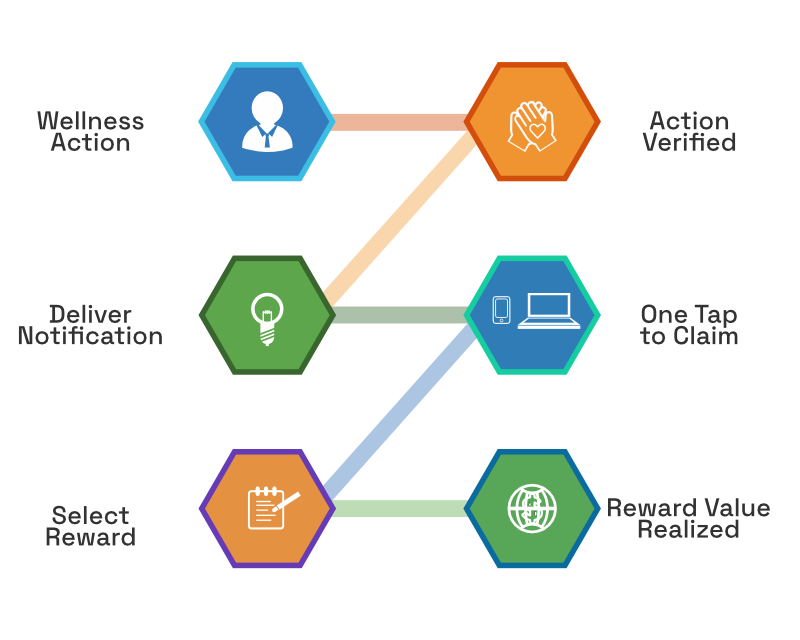
Complete an action → receive a reward.
This simple structure significantly increases participation rates.
Initiatives geared to stress management and mental health awareness are increasingly central to corporate wellness strategies. Yet they often face participation barriers related to stigma, time constraints, or perceived complexity.
Programs may include:
Incentives help normalize participation by reducing hesitation and reinforcing engagement.
When employees are rewarded for engaging with mental health resources, it signals organizational support while encouraging action in a low-pressure way.
Financial stress is one of the most significant but least visible factors impacting employee productivity and well-being.
Programs often include:
Incentives increase participation by making financial wellness more immediate and tangible.
Rather than competing with daily financial pressures, programs become a structured pathway with clear recognition for engagement.
Programs focused on long-term behavior change require sustained engagement by employees over time in order to be effective.
This makes incentives especially important.
Programs may include:
Rather than offering a single reward at completion, successful programs use milestone-based incentives that reinforce progress throughout the journey.
This structure helps maintain motivation during the most difficult phases of behavior change.
It’s important to award progress and not just focus on completion.
For long-term behavior change programs, milestone-based incentives matter most. Rewarding people along the way keeps motivation going when things get hard.
As organizations scale wellness initiatives across hybrid, remote, and global workforces, incentive delivery becomes more complex.
TruCentive is built specifically to remove that complexity of creating, deploying and administering wellness incentives so HR teams can focus on outcomes rather than be unduly burdened by logistics.
Digital gift cards, merchandise, travel experiences, financial rewards, and lifestyle products.
Employees choose what matters to them.
Incentives may be delivered immediately after participation, reinforcing and rewarding the action quickly.
Connect rewards to behavior, driving change.
Centralized tracking with compliance, approvals and accounting as well as automated distribution and follow-up.
Minimal administrative burden for HR teams.
Support fitness challenges, preventive care, mental health, financial wellness, and behavior change programs.
Single platform makes new programs simple.
Corporate wellness is about creating programs and improving participation in programs that already exist.
Organizations that lead in wellness ROI are shifting from a mindset of “offering programs” to designing participation systems.
Incentives are foundational.
When employees are empowered to participate, and rewarded in ways that matter to them, wellness programs stop being something employees have access to, and become experiences they actively choose to engage in.
A short demo is the perfect way to show you how TruCentive can help you realize your rewards, gifts, or payout goals in a real-world scenarios.

We use cookies to improve your experience on our site. By using our site, you consent to cookies.
Manage your cookie preferences below:
Essential cookies enable basic functions and are necessary for the proper function of the website.
Statistics cookies collect information anonymously. This information helps us understand how visitors use our website.
Google Analytics is a powerful tool that tracks and analyzes website traffic for informed marketing decisions.
Service URL: policies.google.com (opens in a new window)
You can find more information: https://trucentive.com/privacy_policy