
The answer is not that your recipients were uninterested. It is not that your messaging was off. In most cases, the reward email never reached them at all.
There is a good chance your incentive reward landed in spam.
And your platform had no way to know.
This is one of the most expensive blind spots in incentive programs today, and most organizations never discover it until the numbers stop making sense.

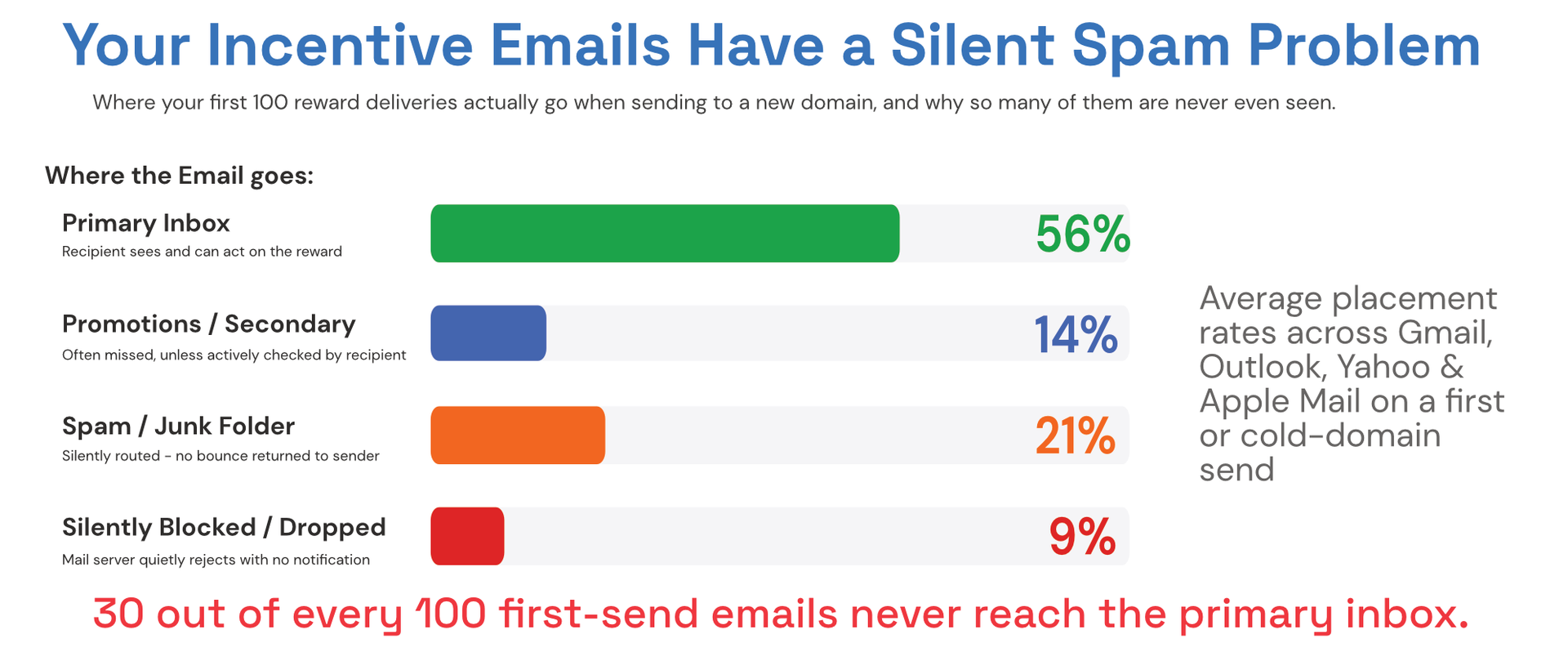
Sources꞉ Validity 2024 Email Deliverability Benchmark Report · Litmus State of Email Deliverability Report · Mailgun Email Deliverability Guide
When your incentive platform sends a reward email, it leaves the server and enters a filtering system that most senders never see. Every major email provider — Gmail, Outlook, Yahoo, Apple Mail — evaluates incoming messages and decides where they belong.
Primary inbox.
Promotions tab.
Spam folder.
Or nowhere at all.
For incentive emails sent to new or infrequent recipients, the data on where those messages actually land is sobering.
of first emails route to spam on average across major providers
Validity 2024 Benchmark Report
silently blocked – no bounce with zero notification sent to sender
Litmus State of Deliverability
recovered from incentives marked delivered that went to junk or dropped
Standard incentive platform policy
Here is the part most incentive platforms do not advertise.
When an email is hard bounced, that is, rejected outright by a mail server, the sending platform receives a notification. It knows the delivery failed. It can flag the address, and alert the sender, so they can remedy the situation and make sure the incentive goes through.
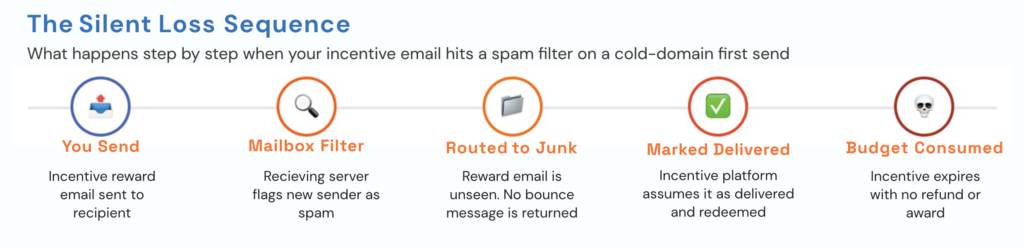
But when an email is routed to spam, nothing is returned. The receiving server quietly files the message away and moves on. No error code. No bounce. No notification of any kind reaches the sender. Your incentive doesn’t go through.
Most incentive platforms interpret that silence as success. The absence of a bounce is logged as a confirmed delivery. The reward is marked as delivered and spent. The budget is consumed. And if the incentive expires unclaimed, the funds are simply gone.
But the delivery report showed that everything worked exactly as intended — even when it didn’t.
This is not a technical glitch. It is how most platforms are built. The system has no mechanism to distinguish between an email that landed in the primary inbox and one that was routed to junk three seconds after it was sent.
Percentages are easy to dismiss. Dollars are not.
If your organization ran a $10,000 incentive campaign last quarter, the placement data suggests that roughly $3,000 worth of rewards may have been marked as delivered to recipients who never saw them. That money did not come back to you. It did not generate a claim and did not produce the engagement, the participation, or the goodwill you were trying to create. It simply evaporated and was recorded as a successful spend.
Scale that across a full year of programs and the loss becomes significant.
For an organization running multiple campaigns it becomes a budget problem that no one has a name for, because the reporting never showed it as a problem at all.
The deeper issue is what it does to your results. When claim rates come in lower than expected, the natural response is to question the incentive, the messaging, or the audience. Teams redesign campaigns. They increase reward values. They run the same program again with adjustments. In many cases, the real cause was never the program itself.
The emails were not getting through, and no one knew.
More than money, it’s your reputation that suffers.
Not every incentive platform handles deliverability the same way. Before your next campaign, there are three things worth confirming with whoever sends your reward emails.
When a reward email arrives from an address your recipients recognize, it carries a very different weight than one arriving from a platform domain they have never seen.
Spam filters evaluate sender reputation, and a domain with no history at a given inbox is treated with far more suspicion than a familiar brand address.
Sending from your own domain also means your organization’s established reputation works in your favor from the first send, rather than relying entirely on the platform’s shared sending infrastructure.
Delivery confirmation tells you an email left the server. It tells you nothing about what happened next.
A platform that provides real visibility into reward page views, link clicks, and claim status gives you an entirely different level of accountability. You can see the difference between a reward that was delivered and ignored, one that was never opened, and one that was opened but not yet claimed.
That distinction matters both for understanding your program’s performance and for deciding where to follow up.
Even a reward that lands in the primary inbox can be forgotten. Inboxes are busy. People forget. A reminder sent to someone who has not opened the email is a different message than one sent to someone who viewed the reward page but did not complete the claim.
The ability to trigger reminders based on actual recipient behavior dramatically increases the number of rewards that are ultimately redeemed. Without that capability, a meaningful portion of your budget will expire unclaimed, not because recipients were uninterested, but because they were busy and no one followed up.
If your current platform cannot give you a clear yes to all three of those questions, you are likely losing money on every campaign you run.
TruCentive was built around a straightforward principle: you should only pay for incentives your recipients actually receive.
Unclaimed rewards are returned to your account automatically at the expiration date you set, whether they went unclaimed because of a deliverability failure, a busy inbox, or simple disinterest.
There is no breakage revenue, no fine print, and no category of loss that gets quietly absorbed into your reporting as a successful delivery.
In 2025, TruCentive returned more than $4 million in unclaimed incentive value to its customers.
That figure represents programs where the platform worked as promised, and where the money came back rather than disappearing into a system that had no way to account for it.
Reminder workflows, real-time claim visibility, and custom domain sending are built into the platform because deliverability is not an add-on. It is the point.
Your budget deserves better than a delivery report that cannot tell you the truth.
A short demo is the perfect way to show you how TruCentive can help you realize your rewards, gifts, or payout goals in a real-world scenarios.


We use cookies to improve your experience on our site. By using our site, you consent to cookies.
Manage your cookie preferences below:
Essential cookies enable basic functions and are necessary for the proper function of the website.
Statistics cookies collect information anonymously. This information helps us understand how visitors use our website.
Google Analytics is a powerful tool that tracks and analyzes website traffic for informed marketing decisions.
Service URL: policies.google.com (opens in a new window)
You can find more information: https://trucentive.com/privacy_policy