
Participant compensation is a central operational responsibility in research, and one that participants and study teams experience directly.
Payments influence recruitment, retention, compliance, and trust. For participants and study teams, compensation is one of the clearest signals of how smoothly a study is being run.
For organizations overseeing multiple trials, compensation management typically follows one of three models:
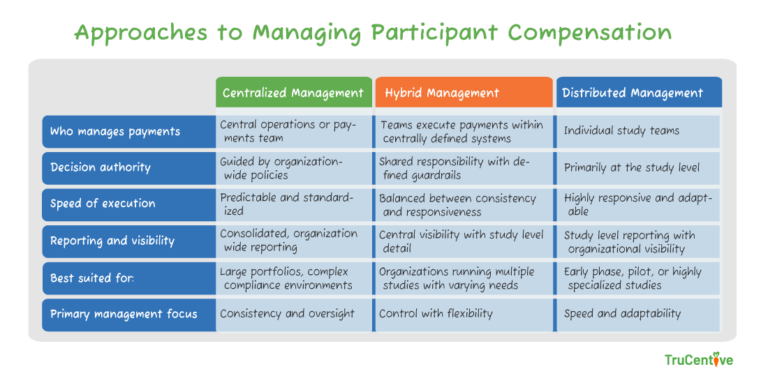
All approaches can work – with advantages and tradeoffs.
The right model for your organization depends on your study portfolio, and how much control or flexibility is wanted at the study level. What matters most is having systems that support your chosen approach without creating friction or unnecessary administrative burden.
This discussion explores centralized and distributed compensation management and highlights potential advantages and disadvantages of each. Organizations run studies most effectively when their compensation tools adapt to their operating model instead of dictating it.
Compensation management is one of the clearest signals of how smoothly a study is being run.
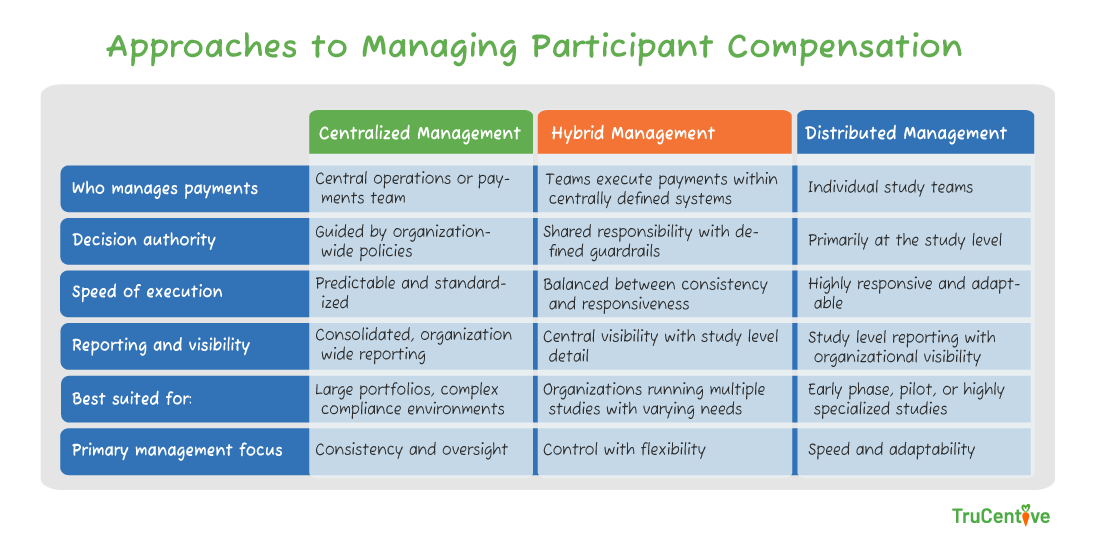
In a centralized model, participant compensation is managed by a central group within the organization. This may be research administration, finance, clinical operations, or a dedicated payments team. Decisions around payment methods, timing, approval, and reporting are made at the organizational level rather than by personnel associated with individual studies.
Centralized teams typically control budgets, define standard payment options, and ensure compliance with internal policies and external regulations. Study teams that are associated with individual studies request payments, but they do not usually execute them directly.
This model is common in large research organizations, academic medical centers, and institutions running many studies at once. It is often chosen to improve oversight and reduce operational risk.
Example
A large health system runs more than fifty active clinical trials across oncology, cardiology, and neurology. Each study has different timelines, but all participant payments are approved by a single central department. Study coordinators submit payment requests through a shared system. The central team reviews, approves, and which issues payments using standardized rules.
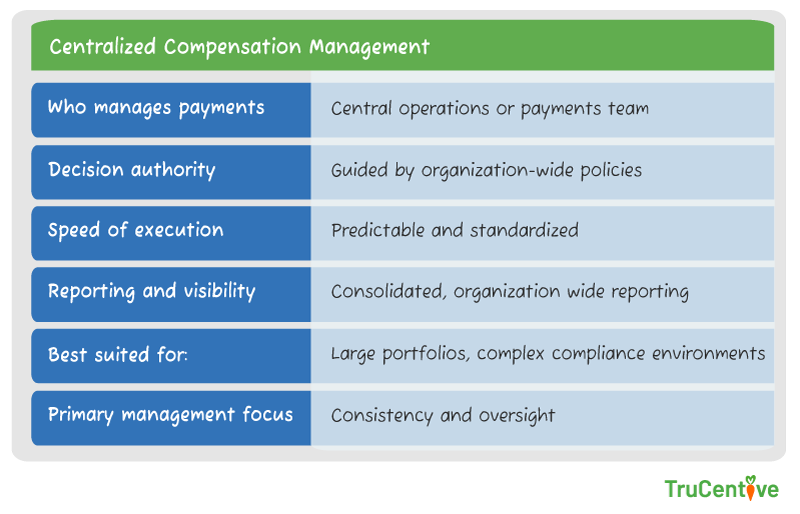
For research leadership, centralized compensation management can offer several practical advantages, particularly in organizations running multiple trials.
Stronger financial oversight by default
When compensation is managed centrally, spending data is naturally consolidated. Leadership has a clear, organization wide view of compensation activity, which simplifies budgeting and forecasting and reduces reliance on manual aggregation. Distributed models can achieve similar visibility, when supported by consistent systems and reporting.
Consistency and compliance
Centralized models make it easier to apply consistent rules around payment timing, methods, and documentation. This consistency can reduce variation across studies and support institutional compliance requirements.
Simplified reporting
When payments flow through one system, reporting is fast and reliable. Leadership can quickly answer questions about participant payments, timelines, and totals across the organization.
Reduced burden on study teams
Centralized execution shifts payment administration, (invoice requests, year end fudning returns, and reporing) away from coordinators and investigators. This can free study teams to focus more fully on recruitment, participant communication, and protocol adherence.
While centralized models provide structure, they can also introduce challenges that research leaders should weigh carefully.
Reduced flexibility at the study level
Central policies may not fit every study. Some participant populations may prefer certain payment types or faster turnaround times. Payment structure review or approval may take longer and can make it harder to adjust payouts when recruitment slows or retention becomes an issue.
Slower response times
When compensation changes are needed to support recruitment or retention, centralized workflows may delay execution. Even short delays can affect participant experience and study momentum.
Distance from day to day study needs
Central teams may not see the daily realities of each study. Without strong communication and feedback, compensation decisions may feel disconnected from participant experience.
Risk of operational bottlenecks
As study volume grows, centralized teams can become strained. This can lead to delays during busy periods or when multiple studies reach payment milestones at the same time.
A behavioral study experiences slower than expected enrollment. The study team wants to offer a small completion bonus. Under a centralized model, the request requires review and approval. By the time the change is implemented, several weeks have passed and momentum is potentially lost.
In a distributed model, responsibility for compensation is managed at the study level. Study teams manage participant payments directly. Coordinators or investigators control when payments are issued and often have flexibility to adjust payments based on current study needs.
This model is common in organizations, early phase research, and environments that value speed and adaptability.
Example
A research organization is running three early phase studies, each with different visit schedules and participant populations. Rather than routing all compensation approvals through a central office, each study team is responsible for managing its own participant payments and approvals within approved budget limits.
Study coordinators issue real-time payments at the time of each visit using a standardized platform.
If a visit is rescheduled, shortened, or combined with another visit, the coordinator adjusts the payment amount to reflect what actually occurred. When one study experiences slower enrollment, the investigator adds a small completion payment without waiting for centralized approval, staying within preapproved guidelines.
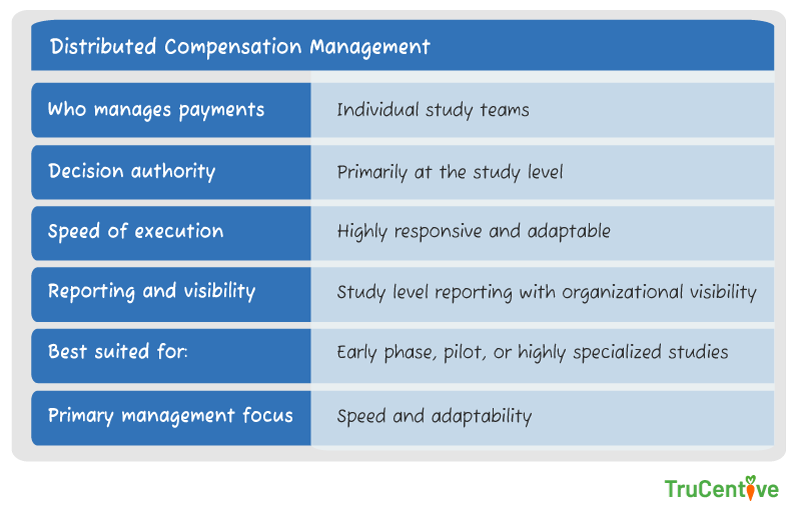
Distributed compensation can offer meaningful benefits, especially for adaptive or fast moving research.
Greater flexibility and responsiveness
Study teams can adjust compensation timing or structure more quickly to address recruitment and retention challenges. This flexibility can be especially valuable in early phase or adaptive studies.
Closer alignment with participants
Study teams interact directly with participants and are often best positioned to understand preferences and expectations related to compensation. Decisions can reflect real-time feedback and study dynamics.
Potentially faster execution
With fewer approval layers, payments can be issued to participant visits or milestones in real-time. This can improve participant satisfaction and reduce follow-up inquiries.
Strong fit for specialized research
Distributed models work well when studies vary widely in design, duration, or participant population and require tailored approaches. This is especially useful in exploratory or iterative research.
For research leaders, distributed compensation management may introduce risks that require effective management controls.
Inconsistent practices across studies
Without shared systems and guidelines, compensation approaches may vary significantly. This can lead to confusion or perceptions of unfairness across studies.
Increased burden on study teams
Managing administrative aspects of budgeting, invoices, or approvals adds operational responsibility to already busy coordinators and investigators. This can pull coordinators away from core research tasks.
Payment and administrative delays
Distributed models without centralized processes may lead to slower, less predictable participant payments. Inconsistent approvals and processing can impact the participant experience, complicate audits, and drive additional follow-up.
Possibility of reduced organizational visibility
Leadership may struggle to get a full picture of compensation activity across studies unless reporting and controls are built into the system supporting distributed execution.
Two studies recruit from the same patient population. One pays participants the same day. The other takes weeks. Participants compare experiences and raise concerns. Leadership becomes aware only after complaints surface.
Most research organizations do not operate at one extreme or the other. The right approach depends on several factors.
These include the number of active studies, regulatory requirements, staff experience, and participant populations. Large study portfolios often benefit from centralized oversight. Smaller or specialized studies may need distributed flexibility.
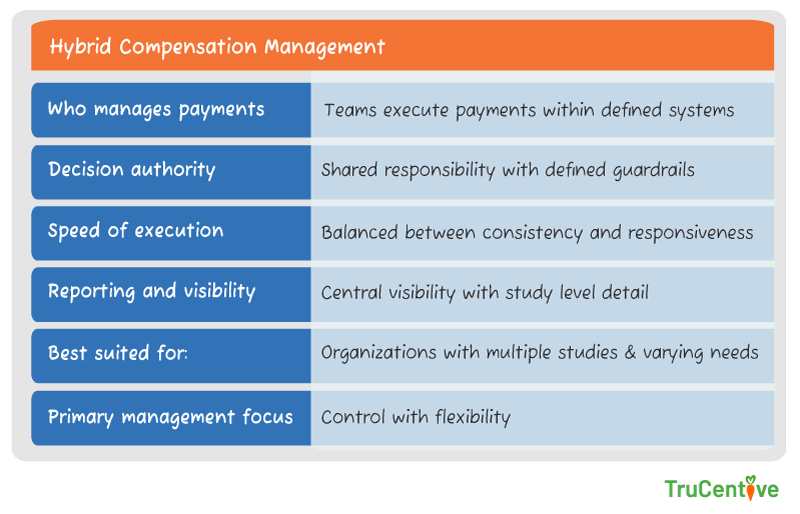
Many organizations adopt a hybrid approach. Core policies and reporting are centralized. Execution and timing are managed at the study level.
The key is alignment. Compensation management should support research goals rather than slow them down.
Regardless of the model you choose, technology plays a critical role. The most effective platforms support both centralized oversight and distributed execution.
Research leaders need visibility.
Study teams need autonomy within defined boundaries. Both are possible when tools are designed with role-based access and clear accountability.
With the right system, leadership can set policies, monitor activity, and report across studies. At the same time, study teams can manage payments efficiently without unnecessary friction.
This flexibility is especially important for organizations running multiple research projects and clinical trials at the same time.

At TruCentive, we understand that no two research organizations operate the same way. Some prefer centralized control. Others value greater autonomy and flexibility at the study level.
Many need both.
Many use a hybrid model, combining aspects of both approaches.
TruCentive is designed to support centralized, distributed, and hybrid reimbursement and compensation models. Research leaders can assign responsibility for specific aspects of compensation while keeping organizational oversight. Study teams can manage participant payments efficiently and consistently.
As research programs grow and evolve, your compensation strategy should be able to evolve with them.
Flexibility is not just a feature. It is a requirement.
A short demo is the perfect way to show you how TruCentive can help you realize your rewards, gifts, or payout goals in a real-world scenarios.


We use cookies to improve your experience on our site. By using our site, you consent to cookies.
Manage your cookie preferences below:
Essential cookies enable basic functions and are necessary for the proper function of the website.
Statistics cookies collect information anonymously. This information helps us understand how visitors use our website.
Google Analytics is a powerful tool that tracks and analyzes website traffic for informed marketing decisions.
Service URL: policies.google.com (opens in a new window)
You can find more information: https://trucentive.com/privacy_policy