
Beyond “Send”: How to Get Rewards Delivered, Claimed, and Appreciated
You sent the reward.
Will your recipient claim it?
Did you set clear expectations?
Was your message recognizable?
Did you follow up with reminders, and again after a claim?
7-minute read
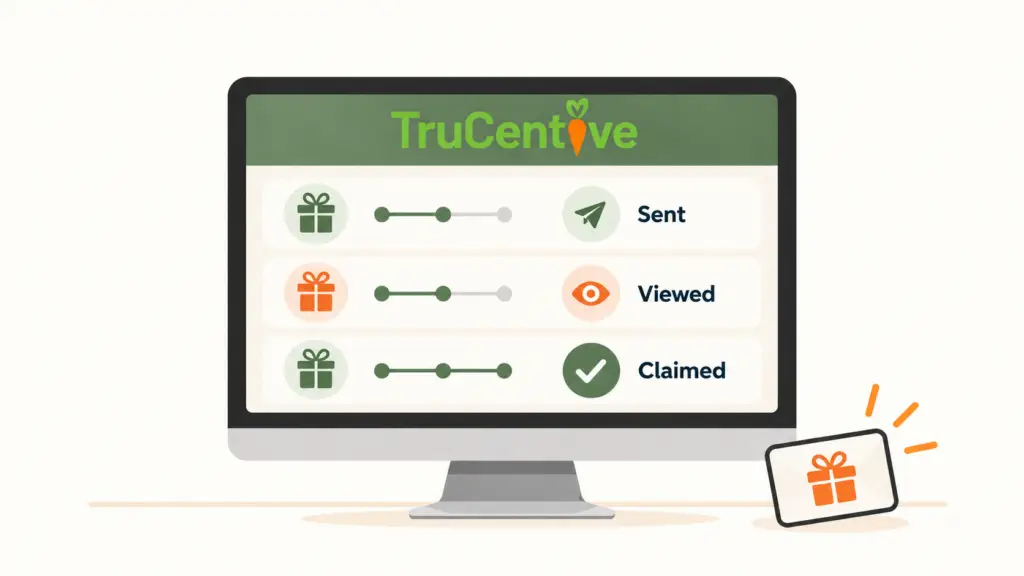
A reward message is only one step in the experience
A customer completes your survey. An employee reaches a milestone. A research participant finishes an interview.
You send the promised incentive—and assume the job is done.
But sending just starts the delivery process. The recipient still needs to notice the message, recognize its source, trust the instructions, follow them, and claim the reward.
For teams using platforms like TruCentive, the advantage is the ability to manage the whole communication sequence: prepare recipients, send a clear message, remind people who haven’t claimed, and follow up appropriately afterward.
1. Make the reward expected before it arrives
The delivery experience begins wherever you promise the incentive: whether it’s a survey confirmation page, an interview invitation, an employee announcement, or a customer conversation.
Tell recipients who is providing the reward and what behavior it recognizes, when to expect delivery, which email address or phone number it will reach, what sender name or delivery partner to look for, and who to contact if it doesn’t arrive.
“Thank you for completing the interview. Your $50 thank-you will arrive within two business days. Look for an email from Acme Research, delivered through TruCentive.”
Use the actual sender details your program will display in subsequent communication.
Introducing a delivery partner beforehand helps recipients connect an unfamiliar platform name with an interaction they remember.
2. Make the sender and message easy to recognize
Choose a clear, consistent sender name, such as “Acme Employee Recognition” or “Acme Research Team.” Where supported, consider sending from an authenticated company domain. A third-party platform can handle delivery while the visible address belongs to your organization. Ask your platform administrator or IT team to confirm the setup; changing the display name alone does not authenticate the email.
Recognition matters. In a Sinch Mailgun survey of more than 2,000 consumers, 94.5% said recognizing the sender or brand was important when deciding whether to open an email. That supports a recognizable identity, although it doesn’t prove a particular increase in reward claims.
Keep the same identity through the initial delivery, reminders, and follow-up.
Recipients should quickly understand: Who sent this? Why did I receive it? What do I do next?
Use a specific subject line:
“Your $50 thank-you from Acme Research”
In the message, connect the incentive to the activity, explain the next step, and provide a visible support contact.
“Thank you for sharing your feedback in Tuesday’s interview. Please select ‘Claim your reward’ to choose your $50 incentive. Questions? Contact the research team using the details below.”
Keep essential information in readable text rather than placing it entirely inside an image. Use one prominent claim button, make the message easy to read on a phone, and explain any genuine deadline.
Google’s sender guidance calls for clear sender identities and links that help recipients understand what to expect when they click.
3. Test the complete delivery before launching
Send a sample through the actual platform workflow. Check the sender name, subject, personalization, images, claim link, mobile display, and support information.
For programs aimed at corporate recipients, include representative work email systems in the test. If many recipients work at one organization, coordinate with that organization’s IT team before a large send, when practical.
Confirm that recipient addresses are current and remove duplicate records. A beautifully designed message cannot compensate for an incorrect destination.
4. Plan reminders before the first send
An unclaimed incentive can mean several things: the message was missed, the recipient postponed claiming, the instructions were unclear, or delivery failed.
Reminders give recipients another opportunity to act. Reminders should be helpful, specific, and limited. For a 30-day claim window, here is a reasonable starting schedule to test, not a universally proven optimum. Day 0 is the delivery date; Day 3 and Day 14 are measured from that date:
| Timing | Message purpose |
|---|---|
| Day 0 | Deliver the incentive and explain why it was sent. |
| Day 3 | Briefly remind recipients who haven’t claimed. |
| Day 14 | Reintroduce the context and offer help. |
| Five days before the deadline | State the actual claim deadline clearly. |
| After claim | Send a relevant thank-you or next-step message. |
Adjust the spacing for your audience and claim window. Avoid stacking several reminders into a short period.
TruCentive supports configurable reminders and post-claim follow-ups. See the current automated reminders overview.
5. Make reminders respond to claim status
Stop claim reminders as soon as the recipient claims. Each reminder should add useful context rather than repeat an increasingly urgent demand:
- First reminder: “Your Acme thank-you is ready to claim.”
- Later reminder: “Still need help claiming your interview thank-you?”
- Deadline reminder: “Please claim your Acme reward by November 30.”
Name the deadline accurately. A deadline to claim an incentive should not be described as the expiration of an already issued gift card.
Avoid “We noticed you haven’t opened our email.” Open tracking is imperfect: Apple Mail Privacy Protection can prevent senders from knowing whether someone opened a message. Use confirmed claim status as the primary basis for stopping reminders.
6. Investigate silence instead of repeatedly resending
If reminders produce little activity, review delivery failures and support inquiries before adding more messages.
Look for patterns. Are failures concentrated at one corporate domain? Did recipients recognize the sender? Did the claim link work? Were addresses entered incorrectly?
A mail server accepting a message does not establish that the recipient saw it. And a lack of claimed incentives does not, by itself, prove that messages went to spam.
Where appropriate and agreed with the recipient, use another channel or a known company contact to help resolve the problem. Resending the same message through the same blocked route may accomplish little.
7. Use post-claim follow-up to close the loop
Once someone claims, the communication should acknowledge that progress. A short thank-you can reinforce the reason for the incentive:
“Thank you again for participating in our research. We appreciate the time and perspective you shared.”
Include useful next steps or support information if needed. If claiming is followed by additional payment processing, describe that stage accurately; don’t imply the money has arrived before it has.
An optional feedback question can help identify delivery problems: “Was your reward easy to access?”
Keep that request brief and clearly optional. Someone who completed the original activity should not feel that another survey or sales conversation is required to receive the promised incentive.
TruCentive supports messages triggered after a claim, including thank-you messages and feedback requests.
8. Measure completed claims and the experience around them
Review claim rate, time to claim, additional claims after each reminder, delivery failures, and support requests. Measure responses to optional follow-ups separately.
Compare reminder schedules or subject lines using similar recipient groups. Change one major variable at a time, and avoid treating every claim after a reminder as proof that the reminder caused it.
The goal is a delivery sequence recipients understand: an expected message, a recognizable sender, a clear action, helpful reminders, and an appropriate acknowledgment once they claim.
Make the delivery experience easier to manage
TruCentive helps teams coordinate incentive delivery, configurable reminders, and post-claim follow-up—and pay only for claimed deliveries.