
SOC 2 Type II attested · HIPAA · PCI DSS · WCAG 2.2 AA · Trust.TruCentive.com
Only pay for claimed deliveries
Support | 415-386-8600
On the surface, the corporate incentive and rewards market looks straightforward. Dig down a little and it is a seriously flawed bazaar. Let’s take a look at incentive and reward mysteries.
Gift cards, rewards and incentives are an important component of recognition and appreciation programs for organizations.

Now there are dozens and dozens of companies vying for your gift card, incentive and rewards business. Many of them advance the fiction that they are “no cost” to you!
But most incentive and rewards programs on the marketplace are not cost-effective and strip value from your reward budget. That leaves you less to devote to the very people who deserve the gift.
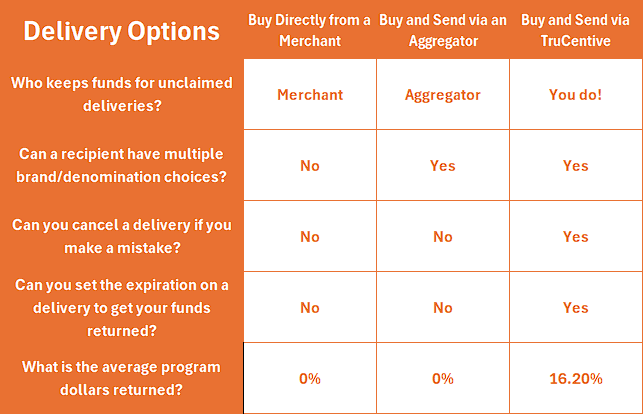
Organizations once purchased individual retail gift cards and distributed them manually. Providers developed services for catalog access, funding, recipient delivery, reminders, reporting, support, and reconciliation. Current models vary: direct merchant purchase, issuer or network products, aggregators, managed platforms, merchandise fulfillment, payments, and hybrid services.
Pricing may include face value, discounts or spreads, per-delivery or subscription fees, service packages, shipping, merchandise pricing, foreign exchange, support, or other contract terms. A “no delivery fee” statement does not establish zero total cost, and a fee-based service is not necessarily more or less cost-effective without comparing scope and outcomes.
Distinguish four concepts: an unclaimed delivery that has not yet been accepted; an issued reward that may carry its own legal and issuer terms; a remaining balance after partial use; and accounting or contractual breakage based on amounts expected not to be redeemed. Ownership and treatment of each amount depend on the product, issuer, contract, accounting policy, and applicable law.
Gift card programs come with a lot of variety and options, but also with a lot of terms and conditions, expiration dates and potential areas that can strip value from your programs.
Reward products and delivery services use varied terms. Before comparing providers, document the program objective, recipient population, funding flow, claim process, reward issuance, support responsibilities, and total cost.
Do not use a general industry redemption percentage to forecast the program. Build estimates from a relevant baseline, test or holdout where practical, and the actual claim, issuance, redemption, cancellation, refund, and remaining-balance data available for the selected product.
Any return of expired, canceled, or unclaimed value depends on the contract, product, funding status, issuer or supplier terms, applicable law, and timing. It is not automatic.
When incentive companies sell you gift cards, they receive the full value of the cards regardless of whether the card is ever redeemed. You pay full price, no matter if the gift is ever successfully redeemed.
Incentive companies know that redemptions don’t reach anywhere near 100%. They get to bank the unredeemed value, not you.
With traditional non-refundable incentive deliveries, every unclaimed or forgotten reward is money left on the table—and it happens more often than you think. According to Paytronix, only 68% of gift cards are ever claimed, meaning over 30% of your budget could simply disappear. TruCentive changes that. Our platform lets you set a specific expiration window for your deliveries—whether it’s days, weeks, or months—so unused rewards automatically expire after your desired timeframe. When they do, the funds return to your account, ready to be reinvested into new campaigns. It’s a smarter way to protect your budget while still delivering an exceptional recipient experience.
Believe it or not, in many states and countries, cards can have expiration dates. When that date passes, the card is no longer redeemable.
All U.S. states adhere to the federal rule that gift cards cannot expire for at least 5 years (either from the date of purchase or the last time funds were loaded)
Several states go further, completely prohibiting the expiration of gift cards.
Most incentive companies limit your ability to track deliveries for a reason: unclaimed deliveries are where they make their money. The less you know about your breakage—your unclaimed or unused gifts—the better it is for them. But for you, it’s not so great to discover you’re effectively paying 30% more than you thought to deliver rewards, gifts, and incentives.
Most incentive companies don’t want you sending reminders to claim gifts. Why? Because every unclaimed delivery is pure profit for them. If participants are reminded, redemption rates go up—and their breakage revenue goes down. That’s why many platforms quietly skip this feature, even though it could save you from losing 20–30% of your budget to unclaimed rewards.
Incentive companies profit from the unredeemed cards.
When digital reward redemption instructions go astray—or when cards are misplaced—the ability to resend them, update delivery emails, or change phone numbers becomes critical. Without these tools, the value is often lost for good… and any unclaimed funds go right back to the incentive company.
Incentive companies tend to offer the options that make them the most money—not the ones that get your rewards redeemed. Limiting recipients to a single type of gift card lowers the chances they’ll actually use it. If they can’t find something they want, they delay… or forget entirely. That unredeemed value becomes pure profit for the incentive provider and erodes the impact of your program.
A CreditCards.com survey found that 52% of millennials and 51% of Gen Z have at least one unused gift card.
The fix? Give recipients real choice. A broad selection ensures they find something they value—boosting redemption rates and ensuring your rewards actually reward.
It isn’t always easy to redeem a merchandise card at full face value. Where does the unused money go if the recipient doesn’t capture it when they redeem the award? This incentive and reward mystery means the unused value usually goes to the card or incentive company. That’s all money lost.
Incentive companies often steer you toward their “recommended” merchandise—not because it’s the best fit for your recipients, but because it’s the best deal for them. They buy select items in bulk at steep discounts, then resell them to you at inflated prices. Add in padded shipping and handling fees, and the true cost of your reward can be far higher than it looks on paper. Don’t think your recipients don’t notice—they know the real value of your options. Those hidden markups mean you’re paying more while your recipients get less, and the incentive company pockets the difference.
What happens when you send merchandise gift options that cost more than the award value? Recipients instantly know that someone else got a bigger reward—and that can lead to frustration, hesitation, or even resentment. When people can’t get what they really want, they may delay redeeming or skip it entirely. A better approach is to show only the items they can get with their award value. That way, the experience stays positive, redemption rates stay high, and you only pay for what’s actually selected.
Too often, incentive company deliveries look more like advertisements for their brand than gifts from yours. They use your budget—and your goodwill—as a vehicle to promote their service, leaving your recognition effort in the background. Every email, SMS, redemption page, and reminder should reflect your brand, your message, and the relationship you’re building—not theirs. Generic, unbranded communications dilute the value of the gift and miss the chance to strengthen your connection with the recipient. You’re the one recognizing and rewarding them—make sure they know it came from you.
Cards and online gifts are convenient. They can reduce much of the guesswork involved in choosing the right incentive for employees and customers by providing recipients with a selection from a vast number of choices.
Don’t get fooled by common incentive and reward mysteries.
Make sure you maximize the value you get from your good deeds.
Build a project in the campaign builder with approved branding, recipient details, eligibility rules, consent records, and incentive selections. Reward availability, pricing, fees, funding, delivery timing, expiration, cancellations, refunds, replacements, remaining balances, unclaimed-value treatment, and tax obligations depend on program terms, reward type, issuer or supplier, and recipient location.
We use cookies to improve your experience on our site. By using our site, you consent to cookies.
Manage your cookie preferences below:
Essential cookies enable basic functions and are necessary for the proper function of the website.
These cookies are needed for adding comments on this website.